What distance will warehouse labels scan from? A good rule of thumb is that the bigger the barcode is, the easier it is to scan. That said, determining warehouse label scanning distance requires considering factors such as how far away a scanner can reliably read it, barcode length, and label size. Getting these right means fewer misreads, quicker scans, and ultimately more efficient operations.
Three Sides of Determining Warehouse Label Scanning Distance
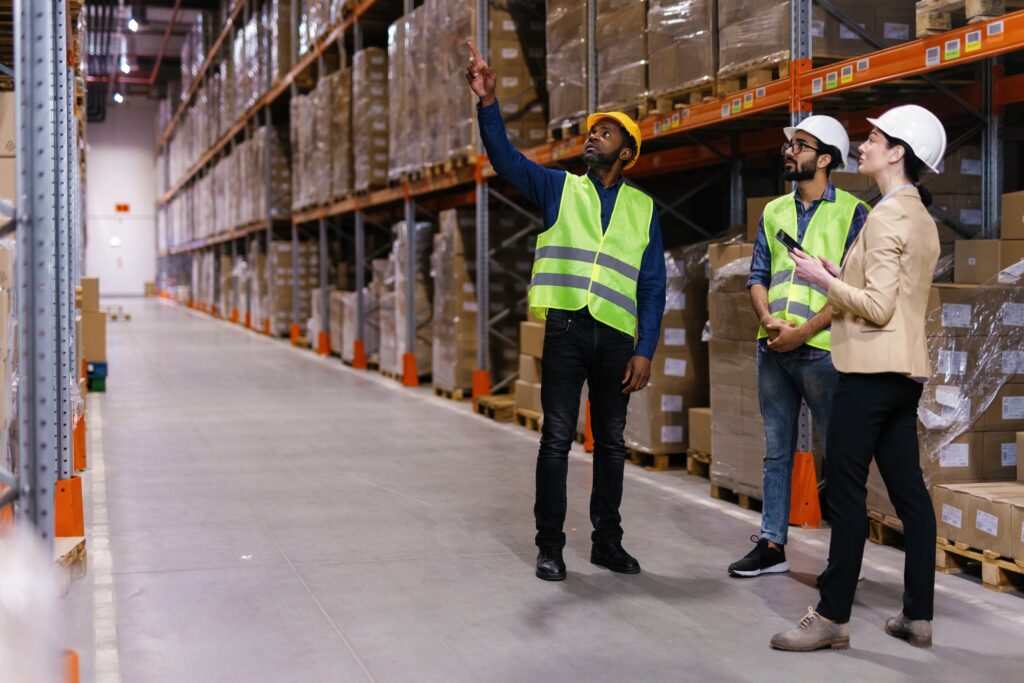
Scanning distance is the measurement of space between a scanner and a label. In applications like high-bay warehouses and lumber yards where long-range scanning is common, finding a label that reliably reads outside of arm’s reach is often a challenge.
The Label Experts at Electronic Imaging Materials, Inc. (EIM) regularly use a simple formula to help customers find labels ideal for their warehouses. Customers need to supply two of three inputs and the formula solves for the third. For a more visual approach, think of it as making a triangle: fill in two sides and the third follows.
- The distance you need to scan from
- The length of your barcode
- The size label needed
Answer any two of these questions and the Label Experts at EIM can tell you the answer to the third.
Scan Distance
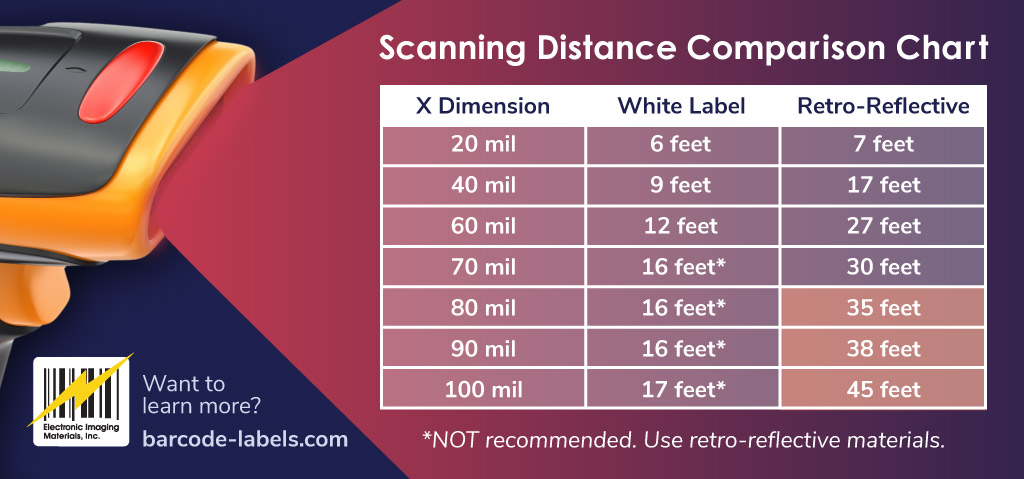
Short-range scanning is comparably easy to specify, but long-range scanning requires more care. Scan distance largely depends on the x-dimension. X-dimension, also called mil size, is the width of the narrowest bar on a barcode. The larger the x-dimension, the greater the scanning distance. Following this logic, to extend read range, increase the x-dimension. But there is another method: retro-reflective labels.
Retro-reflective labels offer another way to extend scanning range. Made with special particles, retro-reflective labels return a scanner’s light directly back to it, allowing it to read barcodes at greater distances. For example, warehouse personnel can scan EIM’s retro-reflective labels from up to 45 feet away. Retro-reflective labels also help with scanning in low-light conditions, like those found in high-density warehouses and tightly packed lumber yards. Don’t believe it? Request samples and see for yourself!
Barcode Length
The bigger the barcode—or more technically, the larger a barcode’s x-dimension—the farther away it can be read. However, many industries mandate specific label sizes, which limits just how large a barcode can be. Because of these limitations, two barcode symbologies stand out for warehouse applications, encoding essential information while remaining readable.
- Code 128 is a popular option for long-range scanning in warehouses. It’s widely supported and, when printed large enough on the right material, is scannable from a distance. It encodes the full 128-character ASCII set, including numbers, uppercase and lowercase letters, punctuation, and symbols.
- Code 39 is another common symbology for long-range scanning in warehouses. Code 39 is lower density than Code 128, making it easy for long-range scanners to read. It encodes 43 characters, including numbers, uppercase letters, and seven symbols.
Code 128 and Code 39 are the most prominent symbologies for scanning long range in warehouses, but they’re not the only ones. Interleaved 2 of 5 has historically been used for barcodes on corrugated cardboard shipping containers, while PDF417 barcodes allow storage of large amounts of data in compact spaces.
Label Size
A practical approach to selecting label size is to opt for the largest allowable label that fits the available space. A larger label allows for a wider barcode, which improves scannability, especially at a distance. Larger label size also provides ample room for quiet zones, empty space surrounding a barcode, which helps scanners identify where a barcode begins and ends.
Other Considerations That Determine Scanning Distance
Not all scanning distances are created equal. For example, retro-reflective labels work best when scanned at flat angles. Steep angles, such as scanning a high-bay bin from the seat of a forklift, are less effective, as much less light is returned to the scanner. Similarly, sawdust, wood particles, and debris at a lumberyard can settle on labels, obstructing the reflective material and inhibiting the return light to the scanner.
Electronic Imaging Materials, Inc.
Have a question about determining scanning distance for warehouse labels? Contact the Label Experts at EIM. Backed by roughly 40 years of experience, the Label Experts can help you determine the size and symbology needed to ensure your labels work as intended. They can also help tailor labels to specific applications, whether it’s moisture resistance for cold chain logistics or UV resistance for an outdoor lumber yard.