You might not recognize the name PDF417 barcode, but you’d likely recognize it by sight. This variable-length, two-dimensional (2D) stacked barcode is used on everything from driver’s licenses and passports to airline boarding passes and event tickets. Its popularity comes from its ability to encode large amounts of data while remaining simple to scan.
Barcode Backstory
PDF417 Barcodes are among the most commonly used 2D barcodes, along with QR Code, DataMatrix, Aztec Code, and MaxiCode. It was created in 1992 by Symbol Technologies, a leading manufacturer of barcode scanners at the time, which was acquired by Zebra Technologies in 2014.
What Is a PDF417 Barcode?
The “PDF” in PDF417 is an acronym for “Portable Data File.” The “417” refers to its structure—each character is encoded using 4 bars and 4 spaces spanning a total of 17 modules, also known as codewords. PDF417 barcodes are customizable, ranging from 3 to 90 rows and between 1 and 30 columns of codewords. It’s worth noting that some scanners cannot read over 20 columns.
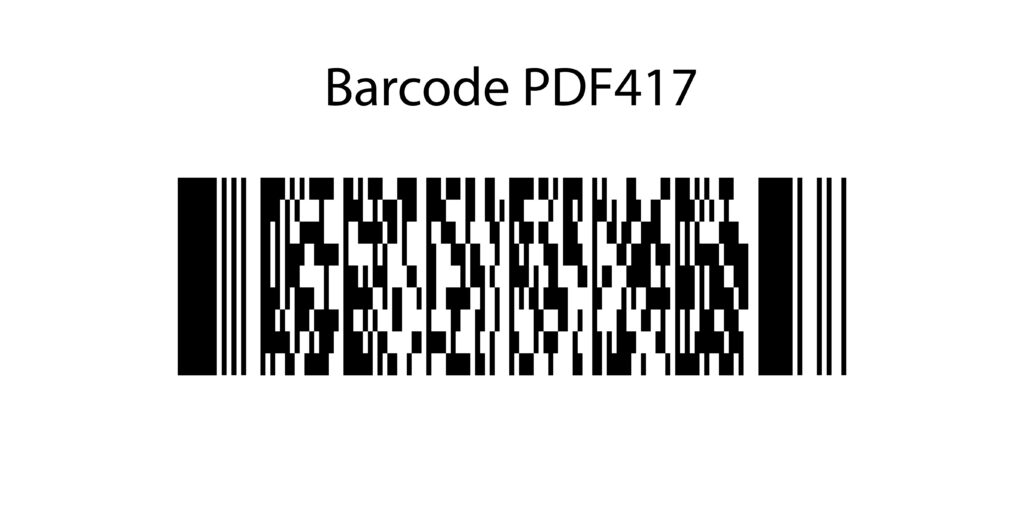
Unlike other widely used 2D barcodes, which are square-shaped, PDF417 is rectangular. A high-density, stacked linear symbol, it can hold large amounts of data, up to:
- 2,710 numeric characters
- 1,850 alphanumeric characters
- 1,108 bytes of digital data
Several different aspect ratios are used with PDF417 barcodes. They’re printed anywhere between 1:2 and 1:5, with 1:3 being the most common.
Pros
There are numerous advantages provided by PDF417, including:
- Versatility: PDF417 supports numeric, alphanumeric, and binary data, making it well-suited to a variety of different applications.
- Customizable: Rows and columns are adjustable, allowing you to tailor it to specific space and data requirements.
- Compact: 2D barcodes store a large amount of data in a condensed space and are optimal for encoding complex information.
- Durability: Remains scannable even when partially damaged—up to 50%—making it an ideal choice for harsh applications.
- Licensing: It’s a public domain format and doesn’t require a license to print.
Cons
Although there are considerable benefits to using PDF417 barcodes, there are also some drawbacks:
- Size: Its large size takes up more space than other 2D barcodes like QR and DataMatrix, as well as 1D barcodes like Code128, making it suboptimal for applications that demand a compact label.
- Scanning: It requires a scanner that can read 2D barcodes and is often sensitive to the angle they’re scanned, which can lead to errors and inefficiencies.
- Accessibility: PDF417 isn’t scannable by all smartphones, limiting its usefulness for consumer-facing applications.
- Printing: High-quality printing is vital to the performance of PDF417 barcodes, which can add cost, especially for large-scale operations.
What You Need to Know About PDF417 Barcodes
Provided the print quality is good and you’re using a 2D scanner that supports PDF417, scanners generally have no issue reading them. However, ensuring even lighting—no glare or shadows—and aligning the barcode parallel to the scanner provides the best results.
Without a scanner, PDF417 is recognizable by its rectangular shape and bold start and stop bars enclosing a highly compacted digital pattern. Upon closer inspection, you can see the visual separations between the stacked rows of codewords.
Variants
PDF417 has two specialized variations: Macro PDF417 and Compact PDF417.
- Macro PDF417: These are used to encode large files too big for one symbol, splitting them into smaller, more manageable sequences of codes.
- Compact PDF417: A popular choice for applications with space restrictions, it has all the same features as a standard PDF417 barcode, with the exception that it’s less likely to scan if damaged.
Additionally, Micro PDF417 is a symbology based on PDF417 that uses a reduced range of row and column configurations to minimize symbol size. The downside is that it encodes less data and is more prone to scanning issues if damaged.
What Are the Common Uses of PDF417 Barcodes?
PDF417 barcodes might not have the name recognition of QR codes, but they regularly appear in applications across everyday life. For example:
- Identification: Driver’s licenses, passports, visas, and other forms of government IDs rely on PDF417 barcodes.
- Airlines: It’s the global standard for boarding passes, encoding important information about the passenger and their flight details.
- Logistics: Widely used in logistics—it’s approved by the United States Postal Service (USPS) and used by major carriers like FedEx—PDF417 encodes data about the sender/receiver, tracking numbers, and delivery instructions.
- Healthcare: Provides quick access to patient information, including medical history, prescriptions, and medication details on everything from patient paperwork to wristbands.
- Events: Encodes information for easy scanning at entry gates about event details, customer data, and seat numbers.
- Inventory: From warehouse to retail, it can store data including product names, manufacturers, and SKUs while allowing tracking of inventory movement.
Electronic Imaging Materials, Inc.
Not sure if PDF417 is right for your application? Let EIM help decode your labeling challenge. Contact the Label Experts and get guidance on finding a label that fits your unique needs—covering everything from print quality and adhesives to layout and barcode type.