As their name implies, mega warehouses are massive facilities that serve as everything from regional distribution to e-commerce fulfillment centers. A mega warehouse’s huge footprint, 24/7 operations, and high inbound and outbound throughput pose sizeable challenges—demands that labels for mega warehouses are engineered to solve.
What Are Mega Warehouses?
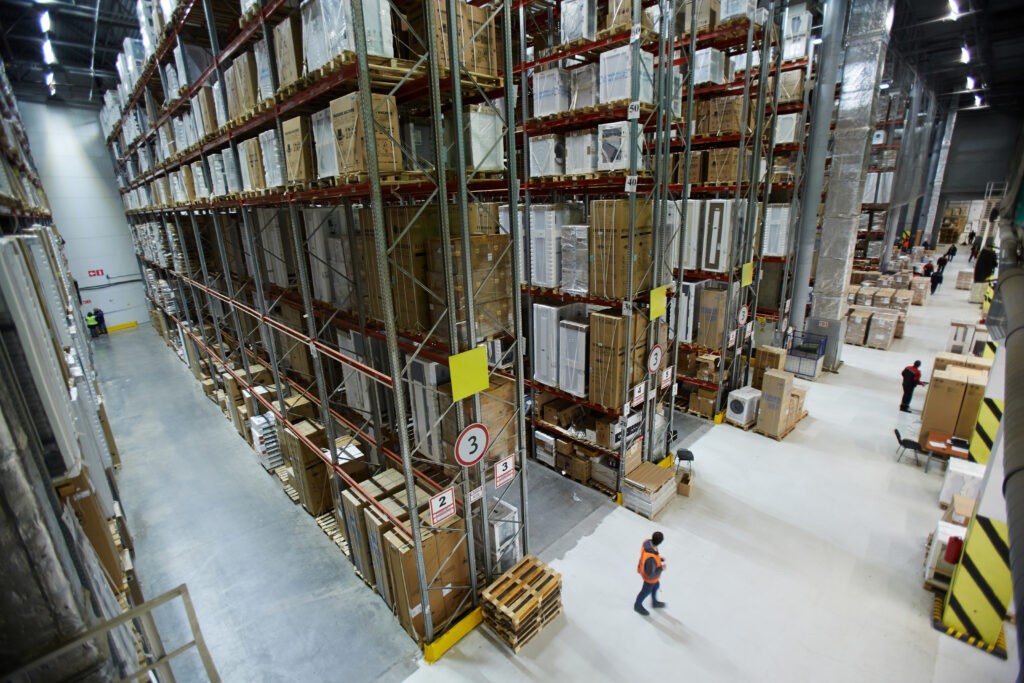
There’s no clear definition for mega warehouses, but the term is regularly used to describe storage and logistics facilities over 200,000 square feet. Although the definition of mega warehouses is still up for debate, there’s no denying that demand is rising for large-format warehouses.
It’s also worth noting that 200,000 square feet is on the small side for mega warehouses, which encompass a huge range of enormous sizes. Consider that the average Amazon fulfillment center is 800,000 square feet, while its Ontario, California, warehouse covers 4.5 million square feet.
Whether a facility spans just a few football fields or truly puts the “mega” in mega warehouse, labels play an essential role in keeping these gigantic facilities organized and operating efficiently.
Mega Warehouses = Massive Challenges
The need to fortify supply chains, consolidate facilities, and meet growing demands—like those presented by e-commerce and big box stores—has fueled the rise of mega warehouses. Labels have become vital infrastructure as businesses scale their operations, helping them overcome the challenges posed by increasingly larger facilities.
High-Density, Vertical Racking
Despite their massive scale, mega warehouses depend on highly complex rack systems to increase usable space. Large distribution centers have looked up to maximize storage, with many warehouses routinely featuring racks topping 40 feet. Operations are also finding space between rack rows by shrinking aisles. Very narrow aisle (VNA) and narrow-aisle warehouses (NAW) typically have 5-10 foot aisles, compared to 12-14 foot rows found in conventional configurations.
Many modern warehouses use both vertical racks and narrow aisles to accommodate a growing number of SKUs and the need to optimize every inch of space, especially in expensive urban areas. Of course, these are just some of the solutions warehouses are using to make the most of their available space, including multi-tier pick modules and dynamic storage.
Retro-reflective labels, like those from Electronic Imaging Materials, Inc. (EIM), provide a valuable solution to the challenges presented by the towering racks and tight aisles of mega warehouses. Retro-reflective labels are scannable from distances up to 45 feet, allowing personnel to scan the tallest racks without leaving the ground. Similarly, their reflective material improves performance in the low-light conditions created by tightly packed rows.
Complex Layouts
Sprawling floor plans, high-bay shelving, and anywhere from hundreds of thousands to millions of SKUs make navigating mega warehouses extremely complex. Clear, well-designed labeling systems are essential for maintaining efficiency at this scale.
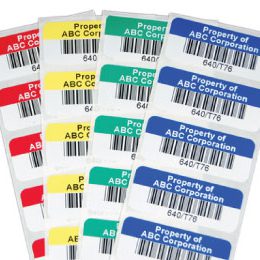
Color-coded totem labels make it easy for personnel to locate and identify items on high shelving above without using long-range scanners. Totem labels display a vertical stack of barcodes, consolidating information into a single location, with every label representing a distinct shelving level.
Color-coding further enhances the benefits of totem labels, enabling personnel to locate the correct item or level quickly and easily, and reducing the potential for mistakes.
Large, High-Turnover Workforce
One of the major challenges facing mega warehouses is staffing: large distribution centers need large amounts of labor. Even with increasing automation, large-format warehouses routinely require staff numbering in the thousands, across round-the-clock operations, with staffing needs heightened during peak seasons.
It’s not merely the number of positions mega warehouses must fill, but also retaining the people in those positions. Warehouse work has historically been a high-turnover field and has traditionally relied on flexible fulfillment strategies, like using temporary hires during periods of high demand, such as the holidays. For example, last year, Amazon announced plans to hire 250,000 seasonal workers.
An influx of a quarter-of-a-million employees is overwhelming on its own, never mind introducing those employees to a busy, high-density environment like a mega warehouse. User-friendly labeling systems provide a valuable visual aid and streamline workflows for long-tenured, new, and short-term staff alike. Labels in mega warehouses provide intuitive navigation, make it easy to identify aisles, racks, shelves, and bins, increase scan speeds, cut labor costs, and reduce errors—improving operational efficiency.
High-Wear Work
Labels for mega warehouses must withstand continuous exposure to foot traffic and equipment like forklifts, automated guided vehicles (AGVs), and autonomous mobile robots (AMRs).
Foot traffic, especially at the high volumes found in mega warehouses, can grind dirt and debris into floor labels, causing abrasion that can both destroy legibility and adhesion. Continuously moving material-handling equipment also poses major challenges for mega warehouse labels:
- Pressure, friction, and force can rip, tear, and peel labels from floors
- Dragging forks and pallets can scrape and scratch labels, leaving them unreadable
- Steady, repetitive traffic can result in wear and rapid label degradation
Damaged and missing labels can wreak havoc at standard DCs and fulfillment centers, and at the scale of mega warehouses can massively disrupt workflows. Illegible or missing labels can create a host of issues for staff, causing confusion, slowdowns, and errors while reducing efficiency and increasing costs.
Essential for Automation
Labels are also vital to automated workflows—products and pallets with compromised or absent barcodes often require manual intervention, negating the advantages of automation.
Labels serve two specific purposes for automation in mega warehouses: identification and navigation.
- Identification: Labels allow robotic picking systems to recognize locations, pallets, racks, and totes.
- Navigation: Labels enable AGVs and AMRs to navigate complex, high-density facilities by providing precise reference points on racks and flooring for position calculation.
Labels are the critical link between the physical world and digital information in a mega warehouse. For automated systems to function in mega warehouses, labels must not only remain legible—withstanding warehouse conditions—but also be precisely positioned. Even a minor misalignment can require human intervention and halt a pick cycle.
Electronic Imaging Materials, Inc.
Labels for mega warehouses might seem like a small consideration for massive facilities with millions of SKUs, thousands of workers, and a fleet of autonomous equipment. However, labels provide the framework that keeps facilities operating smoothly and efficiently. With so much riding on labels, choosing the right supplier is critical. Contact the Label Experts to learn how EIM can help you meet the labeling challenges of modern mega warehouses and keep your DC or fulfillment center operating at its best.