Barcode labels work hard. They deliver everything from traceability and process visibility to quality control and accuracy, often in the harshest conditions. But not all labels are built for every environment. Understanding the challenges facing barcode labels is an important step toward finding a solution that will keep them performing at their best.
The resistance index breaks down the conditions that can cause failure and tells you what to look for in a label that will hold up.
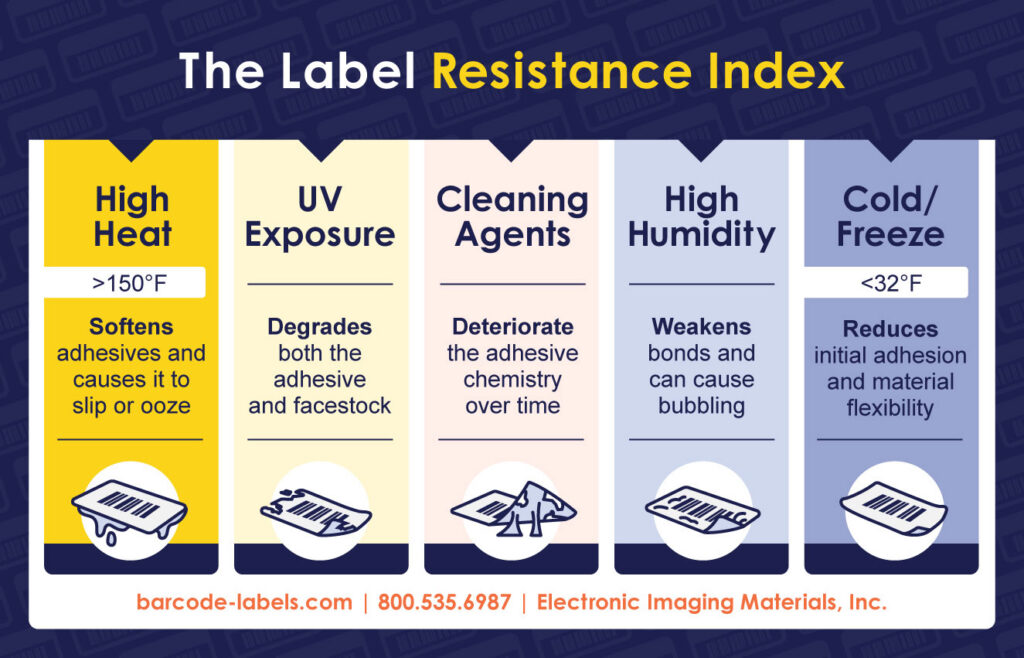
The Resistance Index
Whether it’s environmental factors or exposure to the elements, keeping your labels legible and securely attached is key to effectively tracking items, maximizing uptime, and ensuring efficient workflows.
Heat
Problem: Excessive heat can weaken the bond between label adhesives and the surface to which they’re attached. Moreover, extreme heat can cause adhesives to melt and ooze beyond the label’s edges, attracting dirt and debris, and gumming up the application process.
Additionally, high temperatures can damage paper facestocks, which may burn, degrade, or become unreadable when exposed to extreme heat—especially in applications such as ovens. Conversely, some plastic facestocks can curl or warp in severe heat, making printed information difficult to read.
Heat can also impact print quality. This is particularly true for direct thermal labels, which are produced by applying heat to darken the label surface rather than using ink. Exposure to additional heat can unintentionally darken the material, obscure information, and reduce scanability.
Solution: Polyester, polyimide, and metal labels are the go-to solution for high-temperature environments. For extremely heat-intensive environments—like refineries, chemical plants, and metalworking facilities—there are even adhesive-free options.
UV
Problem: Sunlight creates several issues for labels. UV rays trigger photodegradation, a process that breaks down the chemical bonds in ink, causing it to fade. You may not recognize the term, but you’ve seen the results: patio furniture losing its vibrancy after years outdoors or curtains fading near windows. UV can also negatively affect label adhesive, causing it to peel.
Solution: UV-resistant labels and coatings answer the question of what type of label works best in UV-intensive applications. Flexographic UV inks—which actually use UV light to cure the ink—add another layer of protection for labels exposed to the sun and eliminate the need for protective overlaminates.
Cold
Problem: Cold temperatures can make labels brittle and inflexible. It can also lead to adhesive hardening and loss of bond strength.
Frost is another challenge labels face in cold applications. Moisture trapped in freezing environments quickly turns to frost, creating a barrier between the label and its intended target that makes adhesion difficult.
Solution: Polyester and polypropylene labels remain pliable in cold temperatures, allowing flush application. Special adhesives are also available that stay securely attached at extreme low temperatures and bond to substrates beneath frost.
Moisture
Problem: Moisture, such as humidity and condensation, can prompt labels to peel or, at worst, degrade. It can also cause ink to smudge and become unreadable.
Solution: Labels made of synthetic materials such as polyethylene and polypropylene resist moisture better than paper labels, which can disintegrate. Thermal transfer printing and resin-based ribbons are ideal for moisture-laden applications.
Chemicals
Problem: It’s common for labels in industrial, automotive, and lab applications to encounter a variety of cleaning solutions, solvents, and oils, all of which can break down adhesives and facestocks.
Solution: A variety of chemical-resistant labels are available. However, like choosing a label in general, it’s important to know what you’re up against. EIM offers labels that stand up to everything from bleach and acetones to gasoline and brake fluid to ethanol and DMSO. We even have a label that can survive exposure to xylene.
Surface
Problem: The surface a label is applied to can present its own challenges. Materials, such as silicone, rubber, and powder-coated paints, have low surface energy, making it difficult for adhesives to bond effectively.
Other surfaces, like rough wood, provide minimal contact area for labels to attach to. In other cases, labels must maintain a secure bond with oily surfaces, like those found in manufacturing and machine tooling.
Solution: Label options are available for even the most challenging surfaces. For example, our SiliCode™ labels are engineered to adhere permanently to silicone and silicon-coated materials. The adhesive used on our 548 Matte White Plastic Label seeps into the pores and crevices of rough, textured surfaces, creating a secure bond on everything from rough wood to rubber tires.
Static
Problem: Valuable components like printed circuit boards are susceptible to electrostatic discharge damage during manufacturing and throughout their lifecycle.
Solutions: Antistatic barcode labels use specialized materials to reduce the charge generated when a label is removed from its backing, as well as minimize charge buildup on its surface after it’s been applied.
Abrasion
Problem: Lengthy workflows, regular movement, and frequent handling can result in wear and tear on labels on high-use items, ultimately rendering them unreadable.
Solution: Durable materials like polyester and polypropylene, in conjunction with thermal transfer printing using a resin ribbon, are a tried-and-true method for creating rugged, abrasion-resistant labels. Protective laminates are another option when designing tough, long-lasting labels.
Tampering
Problem: Tampering and counterfeiting can threaten the authenticity, integrity, and safety of products. Tamper-evident labels help defend items from compromise and ensure trust throughout their lifecycle.
Solution: Depending on the need, several tamper-evident solutions are available, ranging from perforated seals—like those used on a bag of coffee or a bakery box—to destructible labels that break or crumble when removal is attempted.
Based on the application, tamper-evident labels are made from vinyl, polyester, or other substrates and use adhesives chosen for the surface, handling conditions, and environments they’ll face.
EIM Label Experts and Real-World Testing
Understanding what your labels are up against in the real world is critical to finding the right solution for your application. EIM’s Label Experts draw on decades of experience to help you select the optimal label, validating performance with real-life testing for the environment, conditions, and surfaces your labels will face.
Contact the Label Experts at Electronic Imaging Materials to learn how we can provide a solution to your labeling problems, or request samples to see firsthand how our labels stand up to your resistance requirements.