From first scan to final shipment, barcodes play an essential role in every step of today’s large, fast-moving warehouse operations. They’re the interface between embedded data and the computers that decode it. The right scanner for your application can have an enormous effect on your operation—streamlining processes, increasing efficiency, and ultimately improving your bottom line.
Here’s what to look for in a handheld warehouse scanner.
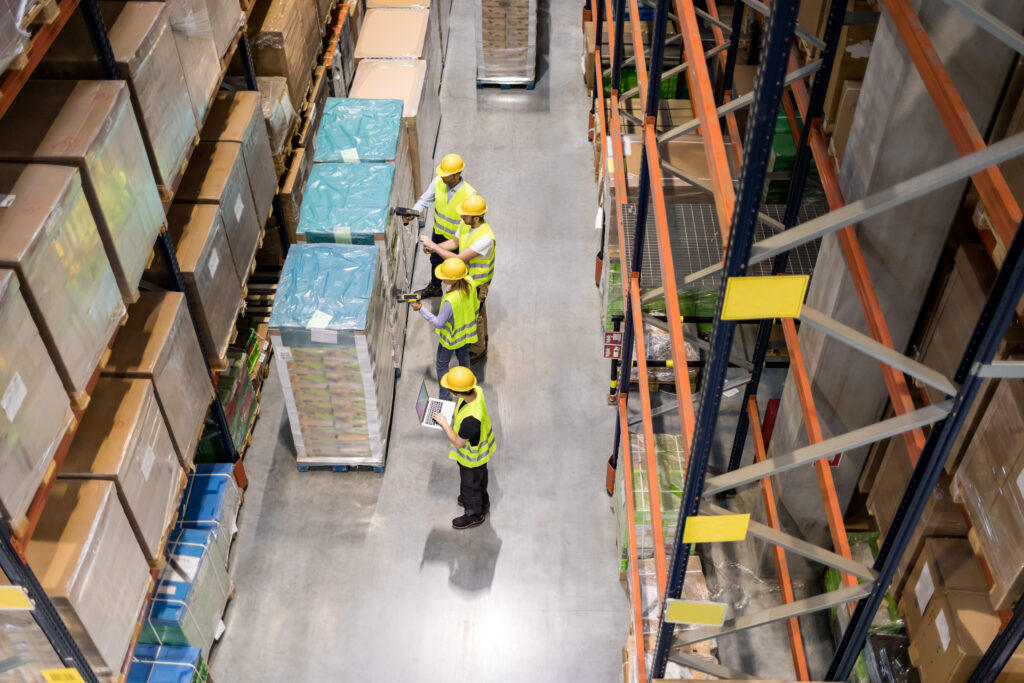
Understanding Your Warehouse Workflow
One of the key factors in selecting the right warehouse scanner is your workflow. Fixed-mount scanners remain popular in some warehouse applications, like high-throughput pack-and-ship or case-picking stations. That said, handheld scanners are the most commonly used device in warehouse environments. They’re ideal for:
- Receiving
- Order picking
- Putaway and stowing
- Auditing and cycle counting
- Packing
- Shipping and staging
A drawback of handheld scanners is that one hand is always occupied, which can make some tasks that require two hands challenging—for example, handling large items, opening cartons, or building pallets.
What Barcode Structure Are You Scanning?
The best scanner for your warehouse largely depends on the type of barcode you use. 1D barcodes have been a staple of warehouse operations for roughly 50 years, but 2D barcodes are becoming increasingly common.
1D Handheld Barcode Scanners
Traditional laser and charge-coupled device (CCD) scanners are ideal for warehouses with simple, linear 1D barcodes like UPCs and EANs. Built for speed and cost efficiency, these scanners excel in applications where barcode placement doesn’t vary.
2D Handheld Barcode Scanners
2D image scanners provide warehouses with versatility, as they can scan both 1D and 2D barcodes, such as QR and DataMatrix Codes. 2D barcodes provide a host of benefits to today’s warehouses—for example, they offer dramatically more data capacity, better error correction, and high reliability. Another advantage of 2D barcodes is that they can read barcodes at any orientation—meaning the scanner doesn’t need to align with the barcode. This makes scanning faster.
1D vs. 2D Handheld Barcode Scanners
As 2D scanners become more commonplace in modern warehouses, the price gap between them and 1D scanners has narrowed. Investing in 2D scanners can help future-proof your operation, ensuring your warehouse is adaptable to evolving standards, even if your current needs only require 1D scanning capabilities.
Key Handheld Barcode Scanner Considerations
In addition to the types of barcodes your warehouse uses, there are a number of other factors to consider when selecting a handheld scanner.
Cord vs. Cordless
Cordless, or wireless, scanners have become the standard in most warehouses.
- Cordless scanners allow workers to move freely between aisles, bays, and stations, while eliminating cord tangles and tripping hazards.
- Corded scanners are reliable, cost-effective, and don’t require batteries; however, they limit personnel to a fixed station.
Another factor to keep in mind is battery life. The best hand-held scanners last a full shift, but round-the-clock facilities need a charging plan or spare batteries.
Connectivity
It goes without saying, a barcode scanner must work with your existing infrastructure. Most warehouses rely on WiFi to connect scanners with their warehouse management system (WMS). WiFi paired with cloud-based systems provides instant updates and real-time access to stock levels, product movements, and inventory levels.
Although WiFi is the most common way for scanners to connect to warehouse infrastructure, it’s not the only option. Other connectivity methods include:
- Bluetooth scanners are often paired with tablets and mobile devices for quickly transferring information without worrying about network disruptions. Bluetooth scanning can also help control internet expenses and is more energy-efficient than WiFi—resulting in lower energy costs and longer service before recharging. Bluetooth scanners have a shorter range than WiFi scanners, which is worth considering if your facility is large.
- USB scanners plug directly into a computer and provide fast, dependable scans without the hassle of internet connectivity or Bluetooth pairing. Of course, this comes at a cost—namely reduced mobility and cumbersome cords.
Can you use smartphones for warehouse scanning? Technically, you can. However, phones are slower, have shorter battery lives, and are considerably less rugged than purpose-built scanners. A smartphone may work well for making a few scans, but warehouse operations making hundreds to thousands of scans a day demand dedicated hardware.
Scan Range
Your facility layout will also influence the selection of the ideal handheld barcode scanner. Standard scanners work best at distances between one and two feet—within an arm’s length or with items you can reach out and touch. Because of this, standard scanners are best for short-range tasks, such as those at workstations or picking from lower-level shelves.
Vertical and multi-story warehouses require long-range scanners, which are capable of reading barcodes from up to 70 feet. Long-range scanners are also ideal for forklift operations, as they enable operators to scan without stopping or getting off the machine.
Durable Construction
Warehouse operations are tough on scanners. Long shifts, drops, dust, moisture, and extreme temperatures are just a few of the challenges presented by warehouse applications. Investing in scanners with high IP ratings—between IP65 and IP67—which have been tested to withstand drops is a sound strategy. Those with refrigerated facilities will also want to consider scanners specially engineered for use in cold-weather environments.
Handheld Warehouse Scanner Scan Speed
Scan speed, or how quickly an image is processed, plays a significant role in warehouse productivity. In large, busy warehouses, even a mild uptick in scan speed can pay huge dividends. A half-second faster scan over 1,000 scans adds up to more than 8 minutes. That’s about 40 minutes a week and almost 3 hours a month. Figure in more scans or more workers and the number grows quickly.
All of the qualities above factor into scan speed, which is why it’s important to select a scanner that meets the unique demands of your application. That is, one that works with your barcode infrastructure, workflow, and environmental demands.
Electronic Imaging Materials, Inc.
Pairing the right handheld warehouse scanner and labels can improve the speed and accuracy of every scan—leading to more efficient workflows and productive operations. EIM can help you find a pick-perfect pairing. Our Label Experts can walk you through the hardware and barcode labels needed to maximize every movement in your facility.