When your team can find, pick, and ship with confidence, everything moves faster. Clear labels are the foundation of that confidence. They tell scanners where to aim, tell people what to pick, and tell your systems what moved from one step to the next.
This guide walks through the seven warehouse labeling solutions that deliver the biggest lift in accuracy. You will see where each label thrives, how it ties into your WMS, and what to watch during installation. If you need a quick win on mis-picks and stock discrepancies, start here.

Why Labeling Drives Measurable Accuracy
Every scan is a data point. If the label is hard to read, in the wrong place, or made from the wrong material, your data quality suffers. The right warehouse labeling solutions reduce rescans, eliminate keystrokes, and help your WMS reflect reality in real time. That translates to fewer inventory adjustments, fewer customer service escalations, and better cycle count performance.
1) Cold Storage and Shipping Labels
Cold rooms, freezers, and refrigerated docks punish paper labels. Moisture, frost, and temperature swings can cause lifting or smearing. Use synthetic facestocks with cold-temp adhesives that grab on first contact and maintain hold as items move from ambient to refrigerated environments. Pair with durable imaging, such as thermal transfer resin, for barcodes that remain crisp after condensation. These work well for case labels, tote IDs, and outbound shipping where scans must succeed at the door, on the dock, and in the truck.
WMS fit: Print-on-demand at pack stations with real-time lot and expiry data. Your system stays in sync as products leave the building.
2) Floor Labels
Floor locations guide put-away, staging, and cross-dock lanes. Permanent floor paint stencils can fade and create confusion. Floor label plates or heavy-duty laminated decals protect the code from forklifts, pallets, and foot traffic. Place them just outside the primary traffic path for line-of-sight scanning and to limit abrasion. For temporary operations, use removable plates that anchor with hardware rather than adhesives.
WMS fit: Map floor zones and lanes to barcode IDs so operators can scan into and out of areas rather than typing location codes.
3) Pallet Labels
Pallet labels carry the identity of a load through receiving, storage, and shipping. Choose durable materials that resist stretch wrap abrasion and condensation. Many teams use dual labels, one on the short side and one on the long side, to ensure access from any aisle. If your facility stacks pallets high, consider oversized barcodes to improve scan distance.
WMS fit: Generate SSCC or license plate numbers at receipt. Each scan ties the pallet to its contents, lot, and destination for strong traceability and cleaner inventory moves.
4) Rack, Shelf, and Bin Labels
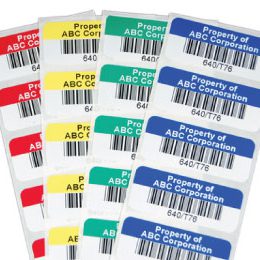
These are the workhorses of slotting and picking. Use high-contrast labels with clear location text, human-readable check digits, and barcode symbology that matches your scanners. If you manage multiple pick faces on one beam, color bands can accelerate visual confirmation without confusing scanners. Align labels on the lower edge of the beam for ergonomic scanning and consistent camera angles.
WMS fit: Encode aisle, bay, level, and position to support path sequencing, replenishment prompts, and accurate cycle counts. This is where inventory accuracy labels have the biggest daily impact.
5) Removable Rack Labels
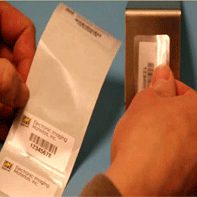
Seasonal re-slotting and remodels can turn permanent labels into scraped residue and wasted time. Removable rack labels use clean-peel adhesives that release without solvents or scraping tools. For long beams with frequent changes, consider magnetic labels. They allow fast reconfiguration while preserving scan quality.
WMS fit: Use bulk reprint templates for rapid re-slot projects. Update location masters in the WMS and apply new labels on the same shift.
6) Retro-Reflective Labels
High-bay storage demands long-range scanning. Retro-reflective labels bounce light back to the scanner, enabling reads from the floor or a lift without slow zoom-ins. Mount them on placards that angle toward the aisle to increase capture speed. Keep codes oversized and leave generous quiet zones to maximize first-pass reads.
WMS fit: Assign each high-bay slot a long-range code. Operators scan from the ground or mast, reducing travel and supporting safer operations.
7) Warehouse Blockout Label Holder
Legacy markings and old slot codes can confuse teams and scanners. Blockout label holders create a clean slate without repainting or replacing uprights. The opaque backing hides old information, while the clear non-stick front lets you swap in fresh labels at any time. This is a fast way to standardize a mixed environment and to keep barcodes uniform across bays and levels.
WMS fit: Use standardized formats for every beam. When you change slotting, swap the label and your WMS stays aligned with the floor.
Best Warehouse Labels: Placement, Materials, and Maintenance
Strong materials and smart placement deliver most of the accuracy gains. Keep these practices in your playbook.
- Pick the right facestock and adhesive. Match synthetic films and adhesive strength to temperature, moisture, and surface texture. Cold rooms, painted steel, and wood all behave differently.
- Design for scanners and people. Use large fonts, check digits, and generous quiet zones around each code. Place labels at consistent heights to reduce search time.
- Standardize formats. Lock in symbology, character length, and color rules by area. Consistency speeds training and reduces errors.
- Maintain labels on a schedule. Replace scuffed or sun-faded codes proactively. Keep a small stock of spares for high-traffic zones.
- Document the map. Tie every label to a location ID in your WMS master. Share updates as part of change control.
These habits turn warehouse labeling solutions into daily accuracy gains that persist after go-live.
Electronic Imaging Materials can provide guidance on materials, placement, and WMS templates. Ask for a quick label audit or sample kit tailored to your racks, floors, pallets, and cold storage.
How Labels Integrate With WMS and Scanning
Your WMS is only as accurate as the scans it receives. Labels act as the bridge between physical movement and system updates. Create templates that pull live data from your WMS, such as lot, batch, or license-plate numbers. Print at the point of work, including receiving docks and pack lines, to prevent transcription errors. Validate barcode grades during user acceptance testing and confirm scanner settings for symbologies like Code 128 or Data Matrix. When you combine strong warehouse label types with sound data flows, your system can track goods with speed and precision.
Choosing the Right Construction for Each Area
The best warehouse labels share three traits. They scan on the first attempt, they stay where you put them, and they make sense at a glance. From there, the details matter.
- Cold environments: Use films with freezer-grade adhesive, printed with resin ribbons for lasting contrast.
- High-traffic areas: Protect floor and pallet labels with laminates or rigid plates.
- Racking and bins: Standardize heights, add check digits, and consider color to speed visual confirmation.
- Change-heavy zones: Use removable or magnetic options to support re-slotting without residue.
A short pilot in each zone will confirm durability and read rates before a full rollout. Capture photos, measure scan distances, and log any rescans to document results.
Warehouse Labeling Solutions That Scale With You
Growth adds more SKUs, more locations, and more people. Labels must scale with every change. Modular placards and blockout holders make expansion easier. Retro-reflective options support taller racking without lifting operators for every scan. Cold storage constructions keep outbound accuracy high during seasonal surges. With the right warehouse labeling solutions, you can scale throughput without sacrificing data quality.
Make Every Scan Count With Electronic Imaging Materials
Your facility deserves labels that make work easier and data cleaner. Electronic Imaging Materials designs and supplies warehouse labeling solutions that match your environment, equipment, and goals. Whether you are evaluating new warehouse label types or refreshing aging locations, we can help you choose the best warehouse labels, set smart placement rules, and connect the results to your WMS.
Let EIM Bring Color and Clarity to Your Labels
You deserve more than a generic label. With EIM, you’ll get:

Tailored guidance on medical device label design
Variable color coding built from your data files
Laminated materials engineered for lab conditions
> Reach out today to get started.