
Stickers, labels, and tags. The terms are often used interchangeably, but there are differences between the three. While they share some commonalities, each serves a distinct purpose and is suited to different applications. And there are straightforward ways to tell them apart.
What’s the Difference Between Stickers, Labels, and Tags?
Labels, stickers, and tags all have their place—discovering what’s best for your application comes down to understanding your needs.
Labels
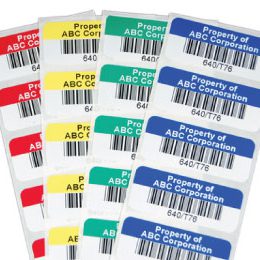
The purpose of labels is to identify and inform about everything, from products to packages to organizational systems. Barcode labels are one particularly popular label type, as they can hold a considerable amount of data in a small space. For example, a QR code can hold up to three kilobytes (KB) of data.
Because labels convey critical information, they play an essential role in a wide range of industries, including:
- Food and beverage
- Industrial and manufacturing
- Laboratory and healthcare
- Retail
- Warehouse and logistics
Because of the important role labels play in communicating information, they’re optimized for practicality and functionality. They must remain securely attached and legible throughout their lifecycle. They must also withstand a range of challenges—such as extreme temperatures, chemical exposure, and rough handling—depending on the application.
Stickers
While labels identify and inform, stickers attract attention and express personality. For example, “I Voted” stickers, “Baby on Board,” bumper stickers, or Chiquita Banana stickers, which have graced the favorite fruit since 1944. Stickers are ideal for applications such as:
- Advocacy
- Branding
- Promotion
- Self-expression
A good rule of thumb for understanding the optimal use for stickers is that they’re for more informal and temporary applications than labels. Stickers are a fantastic medium for bold designs, illustrations, and logos. Printed in high resolution and full color, stickers can be very eye-catching.
Tags
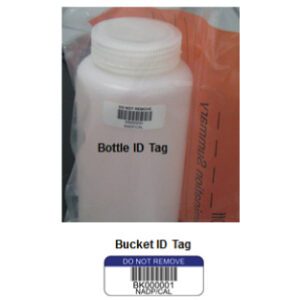
Tags are simply labels without adhesive. They’re attached using methods like clipping, tying, or hanging. Because they don’t use adhesive and are easily removed, replaced, and repositioned, they’re ideal for temporary applications. Common tags include:
- Cable and wire tags
- Inspection tags
- Luggage and baggage tags
- Plant and nursery tags
- Retail hang tags
- Valve and pipe tags
Although tags are commonly associated with items like paper price tags on clothes or plastic tags stuck in the dirt of plants at a greenhouse, they can be quite sophisticated. For example, in January, EIM introduced a new high-temperature tag for steel mills, aluminum foundries, and metal fabrication shops with a service temperature range of 40°F to 1112°F.
How to Choose Between Labels, Stickers, and Tags
Deciding what’s right for you—labels, stickers, or tags—comes down to answering a few simple questions about your requirements.
What’s Your Purpose?
Are you conveying critical information? Or are you trying to build brand awareness or bring attention to a cause? Labels are the go-to choice for delivering data—for example, through barcodes—while stickers are perfect for displaying creative designs, like logos, illustrations, and taglines.
What’s the environment?
Labels are engineered for a wide range of conditions and feature facestocks, adhesives, and topcoats specifically designed to withstand various challenges—whether environmental factors like UV light and moisture or exposure to harsh chemicals. Stickers are built for durability, but their construction is more focused on standing up to everyday challenges than extreme conditions.
How Long Do They Need to Stick?
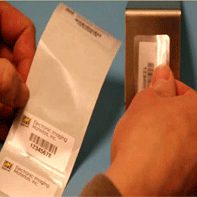
In general, labels are created to last through the lifecycle of whatever they’re attached to. That said, labels like our EverPeel® are designed to be removed and used repeatedly. Tags are another great option for applications that require reuse. Stickers are ideal for shorter-term, one-and-done use.
Electronic Imaging Materials, Inc.
It’s common for customers to get confused and call labels stickers and vice versa. If labelling has you confused, contact the pros. The Label Experts at EIM can help you identify a solution that meets your needs and send you samples, allowing you to test them in real conditions before ordering.