How do you label something that’s engineered to resist adhesion, like silicone? You contact the Label Experts at Electronic Imaging Materials (EIM).
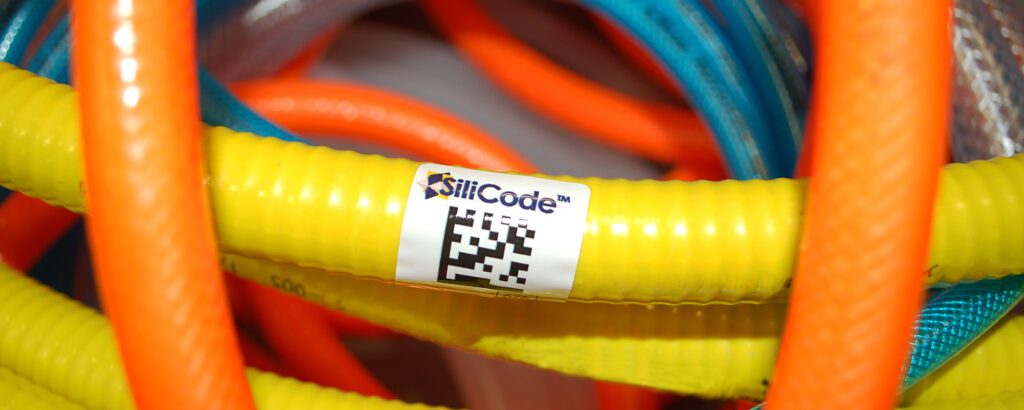
How to Label Silicone?

The issue of applying a label to a non-stick material was posed to us by a manufacturer of silicone tubing for automobiles. Admittedly, Electronic Imaging Materials lacked a label solution for low-adhesion silicone surfaces at the time, but that didn’t stop the Label Experts! Our Products team worked tirelessly to develop a label that sticks to silicone, and thus, SiliCode™ was born.
The Challenge Silicone Presents to Labels
Silicone is an extremely versatile material that features prominently in industries such as automotive, aerospace, electronics, and medical devices. The dilemma presented by silicone is that many of the qualities that make it so versatile also make it difficult to label.
- Low surface energy: Silicone’s non-stick properties prevent traditional label adhesives from forming a strong, lasting bond, which makes securely attaching traditional labels nearly impossible.
- Stretch and flexibility: Silicone can bend and flex (think of the fuel and coolant lines winding around the engine compartment of your car), adding additional obstacles to adhesion.
The best labels for silicone use an adhesive especially designed for silicone and other low-surface-energy materials. They must also offer excellent conformability to ensure they stay affixed as the material moves and stretches.
SiliCode™ Succeeds Where Others Fall Short
By the time the automotive tubing manufacturer contacted EIM, they had already experimented with a number of different types of labels, all with no success. The labels available on the market simply weren’t capable of sticking to silicone tubing—that is, until SiliCode™. Where other labels failed to adhere to the non-stick nature of silicone, SiliCode™ succeeded, thanks to its specially formulated adhesive.
EIM was one of the first converters in North America to offer a label that bonds to silicone and other ultra-low-surface-energy surfaces. Since its release, numerous automotive customers, along with those in other industries, have turned to SiliCode™ for use with silicone-coated parts like airbags, hoses, seals, linings, covers, and more.
SiliCode’s Other Notable Attributes
While adhesion was the notable difficulty facing our autoparts manufacturer, Silicode™ features other qualities that make it ideally suited for automotive components.
- Temperature tolerance: Vehicles operate in a wide range of temperatures, and automotive labels must survive it all. SiliCode™ labels securely attach in temperatures ranging from -112°F to 302°F (-80°C to 150°C).
- Contaminated-surface bonding: Vehicles expose labels to a variety of contaminants. Whether it’s gas, oil, brake fluid, or coolants, Silicode™ labels remain adhered in demanding automotive applications.
- Abrasion resistance: Contact with technicians and tools, other autoparts, and vibration can cause peeling and legibility issues with lesser labels, which is why Silicode™ labels are built tough.
Automotive labels identify and track components and must stay securely attached for the life of the part—often spanning decades and hundreds of thousands of miles. Like the vehicles they’re stuck to, the best silicone labels are built for the long haul.
Electronic Imaging Materials, Inc.
EIM is proud to help customers find label solutions, even for seemingly impossible applications, like silicone. If you have a labeling challenge you can’t solve, contact the Label Experts. We’ll work with you to find the perfect made-to-order solution, even if it requires making a brand-new label!