Pallet labels play a vital role in tracking and identifying products as they move through the supply chain—from manufacturers to warehouses and distribution centers to their final destinations. Adhering to established standards and selecting the right label can streamline every step of the shipping and distribution process.
The Benefits of Choosing the Right Pallet Label
Pallet labels, also called pallet tags or pallet identification tags, ensure valuable assets are accounted for during their journey through the supply chain. This provides operations with many benefits, including:
- Improved efficiency: Clear, concise labeling makes it easy for personnel to identify and route pallets, increasing productivity and reducing labor costs.
- Increased accuracy: Pallet tags can eliminate costly errors, such as losing or misplacing them, while traveling through the supply chain.
- Enhanced traceability: Labels allow stakeholders throughout the supply chain—such as packaging engineers, product managers, sourcing managers, and purchasing agents—to follow products through the distribution network.
- Regulatory compliance: In industries such as food and pharmaceuticals, pallet labels are required to ensure safety and quality, conveying critical information such as production and expiration dates.
Ultimately, pallet labels are where products and the physical supply chain meet data and the digital one.
Pallet Labeling Standards
What are the standards for pallet labeling? While certain industries—like food and pharmaceuticals—must adhere to strict regulations, there is no universal standard for pallet labeling. Rather, tracking guidelines are often left up to individual industries and businesses.
That said, many shippers follow the practices recommended by GS1, a global nonprofit that sets supply chain standards for use worldwide. The most common protocol is assigning pallets a unique, 18-digit serial shipping container code (SSCC), made up of five parts:
- Application Identifier (AI): The 00 at the beginning identifies it as an SSCC.
- Extension Digit: A company-assigned digit (0–9) helps ensure uniqueness.
- GS1 Company Prefix: A distinct company identifier assigned by GS1.
- Serial Reference: The unique number identifying an individual pallet.
- Check Digit: A calculated digit used to verify SSCC accuracy.
Consider an SSCC number like a license plate for pallets—allowing easy tracking and identification as they travel through the fulfillment pipeline.
Optimizing Pallet Label Use
Wondering how to label pallets for optimal tracking, tracing, and managing goods? Below are some tips to help you make the most of your pallet labels.
Readability
An effective label system features barcodes and text, ensuring that both machines and humans can read the labels. Barcodes contain data designed for capture by scanners, while two types of information intended for people can appear on labels:
- HRI (Human Readable Interpretation): the data encoded in the barcode
- Non-HRI: all other information on the label, outside of the barcode itself, such as a company logo, product name, or handling instructions
When labels are easy to decode, personnel work more efficiently and make fewer errors.
Durability
Pallets are commonly subject to demanding conditions, and through it all, their labels must stay intact. Personnel cannot reliably process, handle, or ship items without intact, legible labels. In regulated industries, missing or illegible labels can also lead to compliance issues.
The best pallet labels are made to survive harsh environments and rough handling. Just think of the challenges faced by warehouse pallet labels—including dramatic temperature fluctuations, moisture, exposure to chemicals, and rough handling—which require labels made with rugged materials and high-strength adhesives.
Printer Selection
The readability and durability of labels are, to a large extent, dependent on printer selection. Because of their high quality and durability, most logistics operations use one of two types of thermal printing:
- Direct thermal printing uses heat-sensitive media and is a cost-effective, short-lifecycle option (for use on a pallet that only has to last a single shipment, for example).
- Thermal transfer printing resists smudging and fading caused by extreme temperatures, chemicals, and abrasion, making it ideal for labels that have to last from months to years, such as multi-site supply chain tracking or long-term warehouse storage.
Finding the right printing solution for your operation will fulfill your cost, durability, and scalability needs.
Proper Placement
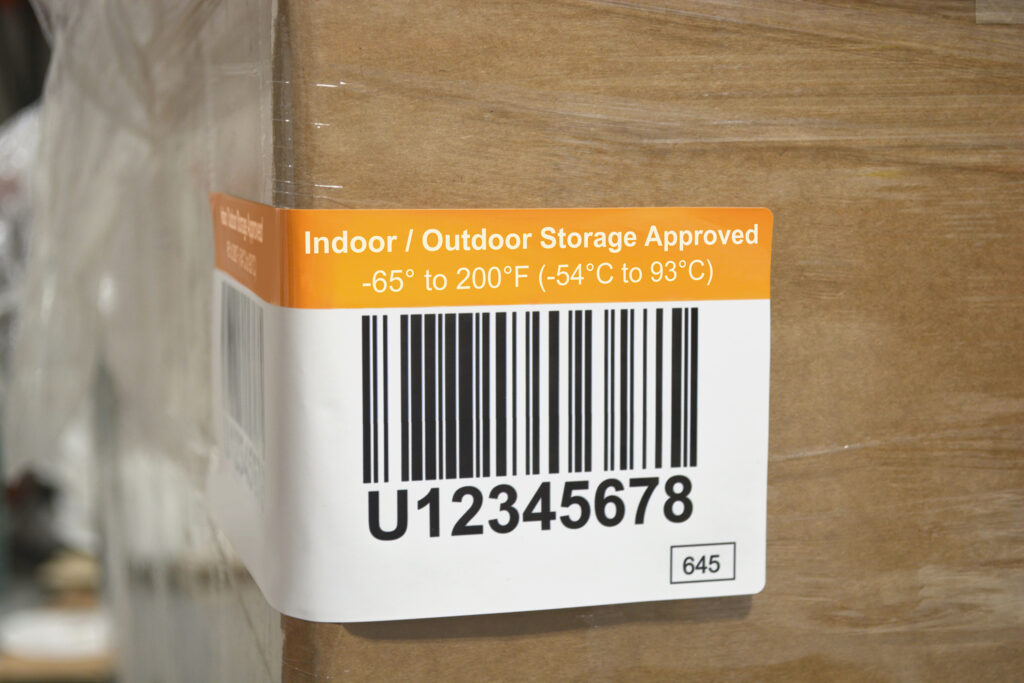
Visibility is key to readability and scannability, and an out-of-sight or improperly placed label can cause a host of issues. Ideally, each pallet will feature two identical labels: one on the long side and one on the short side. This allows easy scanning without repositioning the pallet and provides redundancy if a label goes missing or becomes illegible.
Be sure to place pallet tags as vertically as possible, since labels placed at sharp angles can cause scanning issues. Apply labels flushly to the surface, as bubbles, wrinkles, and creases can all render a barcode unreadable.
According to GS1 standards, labels should be placed between 16 and 32 inches from the base of the pallet. They should also be placed at least 2 inches away from vertical edges—the pallet’s corners—to minimize the chance of damage.
Inside or Outside?
Pallet identification labels are generally affixed to the exterior of the plastic stretch wrap encasing the pallet. Although placing labels beneath plastic wrap offers physical protection, it can compromise text legibility and barcode scannability.
Electronic Imaging Materials, Inc.
Pallet labels are essential to efficient logistics. The right label partner can make the difference between establishing a system that works and one that falls short on delivery. Electronic Imaging Materials offers pallet label solutions for all your needs—from print-your-own blanks to custom-printed, full-color options with graphics on made-to-order shapes and sizes.
Contact the Label Experts to learn how we can help you improve efficiency, accuracy, and traceability through the supply chain. Or, request samples and see why we’ve built a reputation for producing high-quality, durable labels engineered to meet the demands of the distribution processes.