In busy warehouses, small delays compound quickly. Searching for a storage location or trying to scan a worn barcode can slow work across teams and shifts. Warehouse barcode floor labels help employees and equipment confirm locations and keep inventory moving. The right labels must scan reliably, stay securely in place, and withstand constant traffic. Choosing them starts with understanding your facility’s specific needs.
How Barcode Floor Labels Support Speed and Accuracy
Floor labels support more than just packing. They’re a valuable navigation aid in a warehouse, providing benefits ranging from increased efficiency to enhanced safety.
When used with your inventory or warehouse management system, warehouse floor labels help teams confirm locations, reduce manual entry, and keep inventory records accurate. By identifying pick and pack areas, aisles, forklift and pedestrian lanes, hazard and staging zones, floor labels help prevent accidents and keep traffic flowing.
Durability matters just as much as readability. Forklift traffic, pallets, and routine cleaning can damage labels, making barcodes harder to scan. Choosing labels and protective options suited to your floor conditions can help reduce scanning delays and frequent replacements.
Before selecting warehouse barcode floor labels, consider these five questions.
What Surface Are They Going On?
Warehouse flooring creates several challenges for floor labels. The porous surface of bare concrete attracts dust, dirt, and debris, all of which can destroy a label’s ability to bond. Conversely, the sealed and slick surfaces of densified concrete can inhibit adhesion. Another factor is the floor’s condition. Rough, damaged, and uneven floors offer less surface area for a label to stick to and can collect adhesion-reducing debris and moisture.
For some surfaces, proper preparation—such as thorough cleaning before applying labels—can solve most adhesion issues. More difficult surfaces often require floor labels with more aggressive adhesives. Requesting samples and testing under real-world conditions is a smart strategy to discover how they’ll bond to a facility’s floors.
What Type of Traffic Will They Face?
Floors are among the most susceptible-to-damage locations for a label in a warehouse. Just how vulnerable are floor labels? It depends on the type and amount of traffic they’ll endure.
- Will they face heavy foot traffic? Ground-in dirt and debris can render a label illegible over time.
- Will they need to withstand heavy forklifts and pallet jacks? Starting, stopping, and turning on labels can lead to peeling and shearing, along with print degradation.
- Are sliding pallets and scraping skids common? Dragging loads can lift and tear labels, rendering them unserviceable.
The structure of a warehouse’s operations is also a significant factor in selecting floor labels. Facilities with 24/7 operations, continuous traffic, and heavy equipment use are best served by rugged labeling solutions, while lower-use environments can rely on less robust options.
How Long Do They Need to Last?
Warehouse floor labels alone are often not tough enough to withstand the rigors of busy warehouses for long—scuffing, friction, and general wear and tear can make them illegible within weeks or months. Because of this, many operations defend their labels with protective shields and holders.
Several options are available for protecting labels from physical damage. Label shields, like Electronic Imaging Materials, Inc. (EIM)’s FloorCode™ Streamline, are applied over labels. They protect valuable encoded information from scrapes and scratches while mounting flushly on floors to minimize the risk of lifting and tearing from forklifts and pallets.
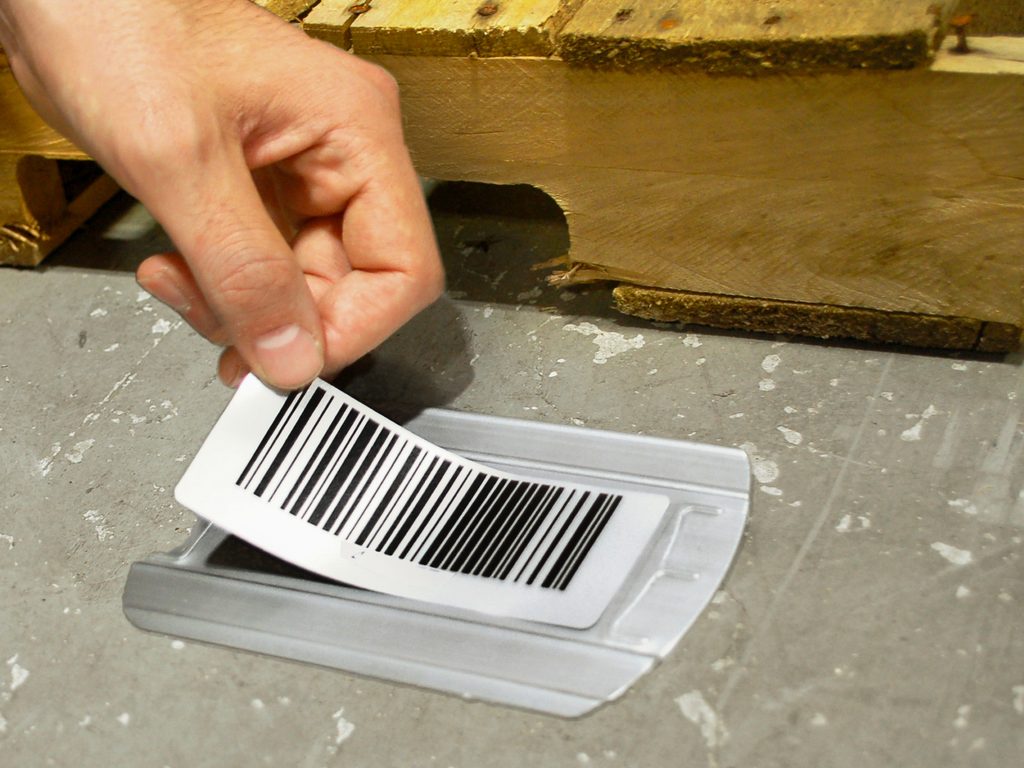
More demanding warehouses often call for even more robust solutions, such as EIM’s FloorCode™ Impact, which safeguards labels with a rugged, bevel-edged, aluminum holder. Ideal for high-traffic and heavy equipment operations, these super-durable holders provide a protective buffer that prevents abrasion and edge damage—keeping labels securely adhered and scannable.
How Easy Are They to Apply?
Some warehouse floor labels are more involved to apply than others. The easiest to apply—and often shortest lived—are often as simple as peel and apply. On the other end of the spectrum are screw-down frames, which offer superb protection, but are anchored into the floor and installation typically requires drilling, special tools, and time. Removal of screw-down frames also often involves floor repair. EIM’s line of FloorCode™ label protectors sits squarely in the middle of the range.
- FloorCode™ Impact is similarly easy to install. Prep the floor, place the barcode label in the aluminum holder, stick the frame to the floor, tamp it down, and wait 24 to 48 hours for the adhesive to adhere.
- FloorCode™ Streamline shields offer straightforward installation and no need for special tools or custom hardware. Simply prep the floor, place the barcode label, add the protective shield, tamp it down, and wait 24 to 48 hours for the adhesive to cure.
EIM’s FloorCode™ solutions provide the protection today’s fast-paced facilities require with the quick-and-easy installation they demand!
Do They Need to Be Removable or Permanent?
Different warehouses and distribution centers have different needs. For example, DCs and replenishment hubs stocking staple grocery items, standardized industrial parts, and pharmaceuticals generally have stable inventories and less shifting of floor labels. Conversely, e-commerce, fashion, and seasonal retail operate with shifting inventories and diverse product lines, which require more agile floor labels.
Standard peel-and-stick labels normally have the shortest lifespan in busy warehouses, while labels protected within screw-down frames are commonly the longest-lasting option. EIM’s FloorCode™ solutions provide an optimal balance of long-lasting protection with the agility essential to facilities with high-turnover inventories and rotating workflows.
- FloorCode™ Impact makes it easy to replace labels within the frame—just peel off the old label and insert a new one.
- FloorCode™ Streamline shields deliver vital protection to warehouse floor labels, but are also easily removed to accommodate layout shifts, workflow changes, and evolving inventories.
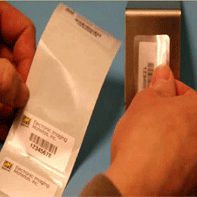
Need to remove a FloorCode™ frame or shield? Simply place a small scraper blade under the holder or shield and lift.
Audit and Replace Labels as Needed
Even the strongest, most durable warehouse labels, shields, and protective frames can succumb to the punishing conditions of today’s high-throughput facilities. Scheduling routine floor label audits is an effective strategy for identifying small issues before they become large problems. It also often illuminates shortcomings in label systems—signs of wear, scuffing, tearing, and peeling might indicate it’s time to bolster your floor labels or shields.
Electronic Imaging Materials, Inc.
Floored that there’s so much to know about warehouse floor labels? Don’t worry, the Label Experts at EIM can help you find the right solution for your facility and send you samples, allowing you to validate their performance before committing to an order. Contact EIM and hit the ground running with your warehouse labels.