Cold chain labels for pharmaceuticals ensure temperature-sensitive products are accurately tracked throughout their journey across the supply chain, maintaining product integrity and regulatory compliance. It’s not only an important job, but a difficult one. Pharmaceutical cold chain labels must remain legible and firmly adhered through deep-freeze storage, condensation, and repeated freeze-thaw cycles—conditions that would cause a standard label to fade, peel, or fail.
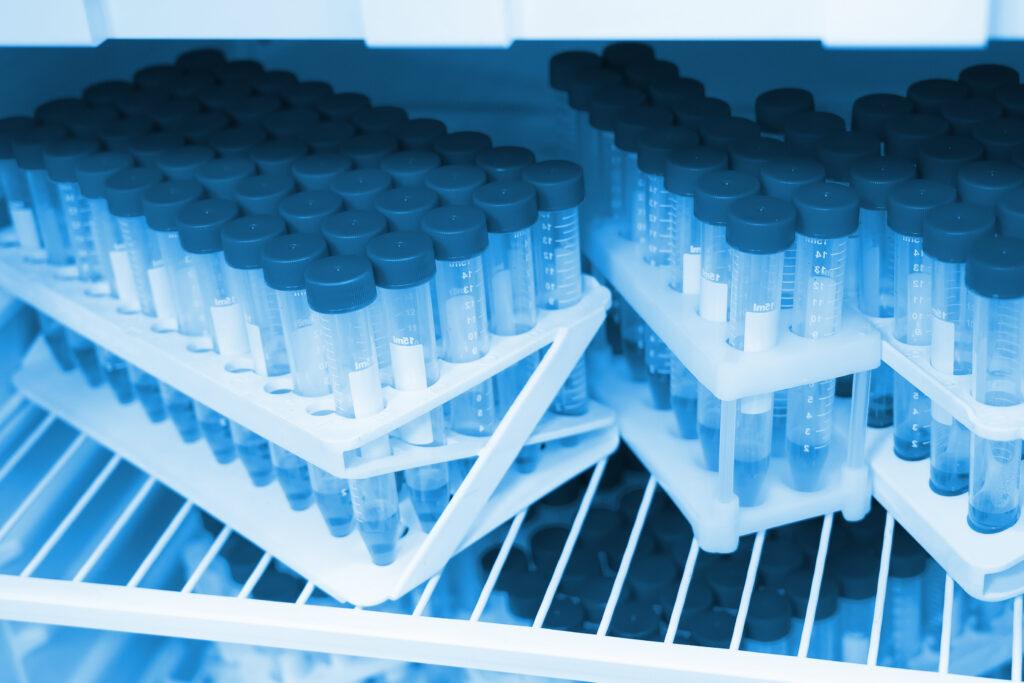
The Importance of Cold Chain Labels for Pharmaceuticals
Cold chain labels play an essential role in the pharmaceutical industry. They provide end-to-end visibility and tracking—from manufacturers and distributors to healthcare facilities and providers.
Facilitate Inventory Management
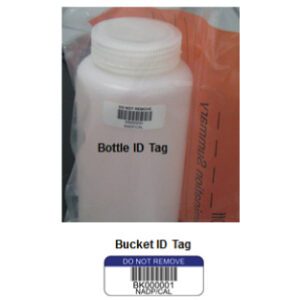
First and foremost, cold chain labels provide reliable identification and tracking of temperature-sensitive pharmaceuticals. Barcode labels encode critical information including:
- Product Name
- Manufacturer
- Batch Number
- Production Date
- Expiration Date
- Storage Conditions
This information is vital in the event of a recall or quality issue—allowing for quickly identifying and pulling affected inventory and facilitating replacement.
Protect Product Integrity
Temperature-sensitive pharmaceuticals, ranging from medications like insulin and GLP-1s to vaccines for the flu and measles, mumps, and rubella (MMR), can all degrade if not stored at the proper temperature. Labels help validate correct storage of pharmaceuticals—along with identifying any breaches—ensuring patients receive safe, effective products.
Barcode label systems ensure temperature-sensitive pharmaceutical products maintain their required environment through manufacturing, storage, and distribution. This enhances efficiency by maintaining data integrity throughout research and study, while also minimizing the discarding or replacement of products on the market.
Compliance and Regulation
Pharmaceuticals are one of the world’s most regulated industries. Agencies such as the U.S. Food and Drug Administration (FDA) have strict standards relating to the identification, tracking, and storage of pharmaceutical products. Non-compliance with regulations exposes organizations to a range of risks, from patient safety concerns to regulatory penalties.
Enhance Operational Efficiency
The cost of researching and developing new drugs is staggering—a 2021 review and assessment found it can range from $161 million to $4.54 billion. With spending at this level, even small-scale efficiencies can have a considerable effect. Consider that the industry loses roughly $35 billion annually due to failures in temperature-controlled logistics.
The Challenges Facing Cold Chain Labels for Pharmaceuticals
Labels face many demands during their lifecycle, from labs and research centers to product distribution and administration. These include:
- Extreme Environment: The cold chain process often exposes labels to liquid nitrogen, dry ice, and temperatures between -196°C and -80°C.
- Small and Unique Shapes: Vials, test tubes, and other containers have limited label space and curved surfaces that are hard to label.
- Data Density: Labels must contain extensive information—often complying with multiple regulatory agencies and appearing in multiple languages.
Whatever application or challenges labels face, they must remain legible and secure.
How to Choose a Label for Cold Chain Processes
Choosing a label for pharmaceutical cold chain processes isn’t all that different from developing a new drug—both are about finding which materials work together to solve a specific need. Consider the following factors when choosing cold chain labels.
Withstand Cold Temperatures
It should come as no surprise that cold chain process labels are exposed to frigid temperatures, often as low as -196°C, far below the temperatures at which standard labels are designed to perform. Labels for freezing conditions require a facestock that won’t become brittle, peel, or lose adhesion, and feature adhesives that maintain their bonds even in extreme environments.
Moisture Resistance
Condensation from freeze-thaw cycles, handling, and transportation can cause labels to smear, peel, and degrade. Labels made with moisture-resistant materials and durable adhesives are optimal. So, too, are labels that use robust printing methods, such as thermal transfer printing with a resin ribbon.
Low Surface Energy
The vials, tubes, and containers used in pharmaceutical cold chains are often constructed with low-surface-energy materials such as polyethylene, polypropylene, and polytetrafluoroethylene. These applications demand special adhesives capable of securely attaching to surfaces notoriously difficult for adhesives to bond to.
Anti-Tampering
There’s a lot at stake when pharmaceuticals move through the cold chain—from patient safety to regulatory compliance to brand reputation. Tamper-resistant labels help ensure product integrity, prevent counterfeiting, and maintain chain of custody. Ultimately, they protect both patients and brand trust.
Lasting Performance
Labels have to last as long as the products they’re attached to. In pharmaceuticals, that’s often a considerable amount of time. In the case of vaccines like those for Chickenpox or Yellow Fever and medications like insulin, this can be years.
Electronic Imaging Materials, Inc.
Selecting a cold chain pharmaceutical label is like developing a drug in more ways than one. Once the right combination of materials is found to solve a need, labels are tested to ensure they deliver the promised results. Only then are they scaled for production.
If you’re interested in learning more about pharmaceutical labels, contact the Label Experts to discover the solutions we offer for your application. Or request samples and see for yourself.